This is current a work-in-progress
UI Challenges
These are a series of online Design Challenges that gives topics for users to work on. The theme for each individual days have been labelled accordingly


The Drive to Contribute
(Thesis Project)
PROJECT TYPE
Social and Community Engagement, Human Centred and Inclusive Design
YEAR
2026
THESIS PROJECT
“I want to help, but I don’t know how to…”
The Drive to Contribute is a nine-month research study conducted within a community, centred around a self-led exercise group named '108' that was initiated at the beginning of the project.
In its early stages, group activities were facilitated, creating space for seniors to come together regularly. Over time, facilitation was gradually stepped back, allowing the group to continue on its own terms and evolve independently. Eventually, the group continued on its own, sustained by the community members themselves.
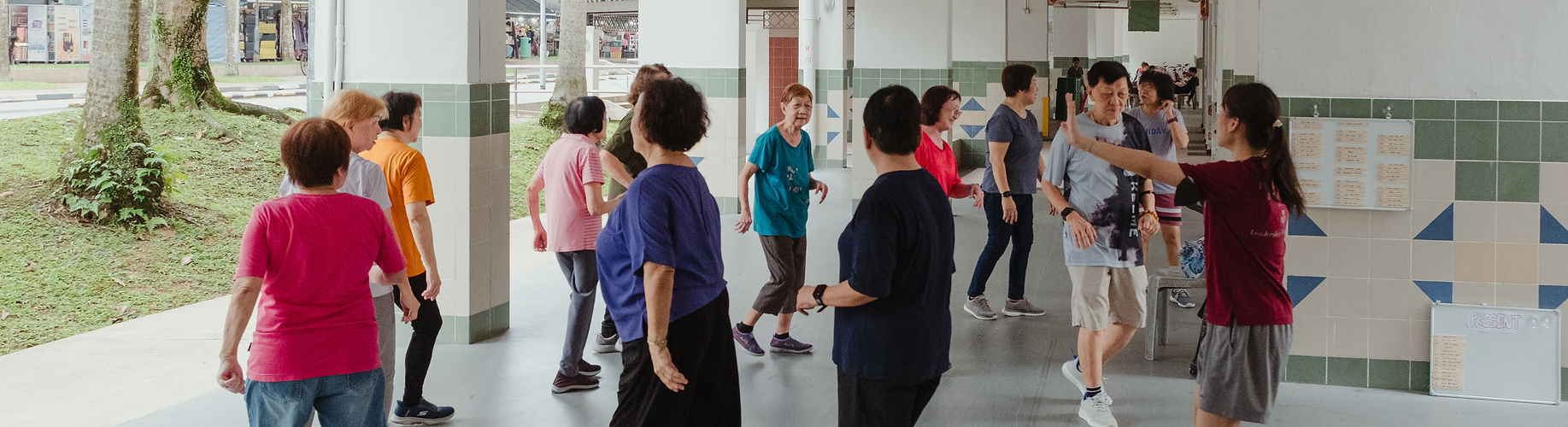
The focus of this project is to examine how seniors in a community participate and contribute, and to question what “contribution” really means.
I explored how seniors perceive contribution in community settings, and how participation doesn’t always reflect their motivation.
So the question I explored was:
Does participation really reflect motivation and contribution in a community?
FACILITATING PROGRAMME
My group mates and I facilitated community programmes by supporting session flow, guiding participant activities, and ensuring smooth coordination between participants and objectives.

As a facilitator, I helped translate the programme design into lived interaction by guiding sessions on the ground, while also observing participant behaviour, engagement patterns, and moments of contribution in real time. Here are some of the ideas we tried:


CIRCLE AND PAIR EXERCISE
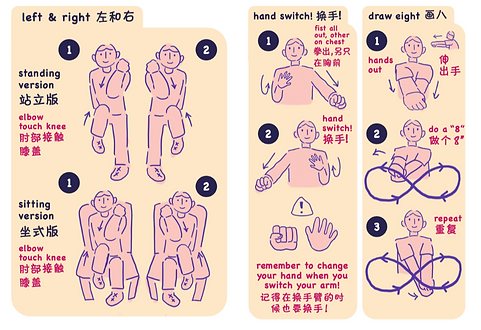
Through circle-based exercises and paired theraband activities, the programme encourages a sense of unity and connection within the community, rather than relying on a traditional leader-led exercise format. Instructions were also adapted into relatable and easy-to-understand cues, enabling seniors to learn more quickly and focus on retaining the movements.

EXERCISE BOOKLET
An exercise booklet was designed and distributed to seniors as a guide for their activities. Beyond serving as a reference for movements, it also functions as an invitation for continued engagement, extending participation beyond the sessions themselves. When seniors express intentions such as “I will share this with my friends,” it further amplifies its reach, turning the booklet into a subtle tool for peer-to-peer encouragement and community participation.
RESEARCH PLAN
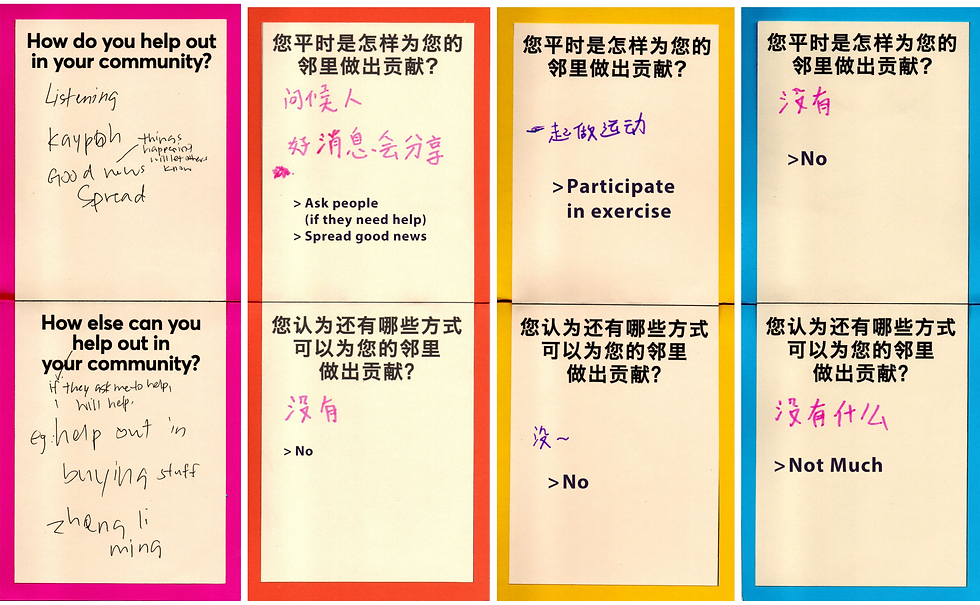
To explore this, I used a mix of qualitative methods. I conducted interviews with seniors, and also designed simple prompt cards to help them express what ‘contribution’ means to them. This was helpful because not everyone is comfortable articulating abstract ideas directly. I also observed community sessions to understand how participation actually plays out on the ground, not just what people say, but what they do.


Quantitative methods
-
Motivation is measured using the Self-Determination Theory (SDT), specifically through the Basic Psychological Needs Scale (9 items). This measures autonomy, competence and relatedness. These needs are essential for growth and wellbeing. When met, they support motivation and mental health.
-
Participation is measured using attendance records documented in an Excel sheet over 19 sessions.
-
Participation levels are compared to identify patterns and relationships between motivation and participation. This explores whether levels of contribution can be understood through this relationship.
Qualitative methods
-
Interviews and conversations with seniors provided insights on a personal level, in a comfortable environment.
-
Open-ended prompt cards were used to understand personal definitions of “contribution.”
-
Observations of participation in real settings were used to capture experiences, meanings and perspectives.
Approach to analysis
-
This study takes an exploratory and interpretative approach, integrating both qualitative and quantitative data.
-
Rather than seeking direct correlations, the analysis focuses on identifying patterns, inconsistencies, and deeper meanings between what people report (motivation) and what they actually do (participation).
-
This allows for a more nuanced understanding of how contribution emerges in context.
FINAL ARTEFACT: PUBLICATION
"Drive to Contribute" is a publication created to consolidate and showcase the research that has been conducted. Beyond presenting quantitative data and key findings, it highlights the rich stories, experiences, and voices within the community.
These narratives provide valuable context to the numbers, illustrating the impact, challenges, and achievements of community members. By combining data-driven insights with human-centered storytelling, the publication offers a more holistic understanding of the community and its collective journey, inspiring greater engagement, learning, and contribution.


